2026-01-25

Quilotoa Loop, Ecuador

Quilotoa Loop is the first hike we did in Ecuador. Fantastic 3-day hostel-hopping hike, with rich culture experience and natural beauty sighting. 

To be honest, the hardest part was to get to the starting point. For this Ecuador trip, we first landed in the city of Quito, capital of Ecuador. A lot of people start adventure in Ecuador there. We stayed at a hostel in Quito on the arrival day (after midnight), then did a city walk tour on the second day. The third day, we took bus to do Quilotoa Loop. The hike starts in a small village called Sigchos. From Quito, you first need to go to a bigger city Latacunga, because there is no direct bus from Quito to Sigchos. We took metro to go to bus terminal in Quito, then we bought a bus ticket to Sigchos, but when we went to bus area, the bus had gone already. So we had to buy a ticket again. We needed to go to a bus terminal in Latacunga, but our bus' destination was not Latacunga, just the bus went through Latacunga, so the bus dropped us off the middle of road. In Ecuador, there are no bus designated bus stops: they can get off or get on wherever they want. Now we had to go to the Latacunga bus terminal but those buses are not many, but luckily one bus passed by and we were able to get on. It was super rare, the second bus driver, who was young and spoke English and he kindly told us the we needed to by a bus ticket to Sigchos in the terminal. Interestingly, he said that I look like Ecuadorian! Probably because I am short and black hair (Those are general looking of Ecuador indigenous people). After the second bus, we FINALLY arrived Sigchos. We had coffee in a small cafe in Sigchos. 

Day1: ~6 miles, ~1500 feet elevation gain. First, going down in the valley in lush green scenery. Nice to see small villages and agricultural view. This is the real culture witnessing. One thing really stunning is that, many steep hills they grow the products and observed many times farmers were working on the hill by hands, without any machines. More than half of the farmers working on the field. were women with babies on their backs. That was surprising. 
Going through villages, we saw many dogs without leashed. This reminded me of Montana (East Glacier) where many dogs roaming on the roads. The dogs barked a lot while we passed, but they didn't come too close or bite. Among animals, the best was llama (left picture). 
Many llamas are in Ecuador, and indeed, the first night's staying was called, "Llullu Llama Mountain Lodge" shown in the left picture. Really nice cozy place. For 2 of us, with breakfast, dinner, packed lunch, private double bedroom, shared shower and bathroom, unlimited coffee/tea, spacious communal area: $65. One person with 2 meals costs only $32.5?! Such a good deal. AND the meal is very good. For example, the dinner was 3-course meal! Starter is soup (it family style with other travelers): it was very good broccoli soup. Then main dish was meat. Then, dessert was home made cake. All delicious. We had 7 hikers total on that night. Two guys from Netherland, two twin sisters from England, a guy from Montreal, Canada, and us. The breakfast was also amazing. Fresh cut fruits including passion fruits, yogurt, fresh smoothies, bread with butter and jam, eggs. Handmade tuna sandwich for lunch was very tasty as well. 
Day2: ~7.4 miles, ~2500 feet elevation gain. 2nd day was another beautiful day, with lush green views. One point when we crossed the river, an old guy spoked to us in Spanish and was saying his wife had surgery and (likely) begging money. We left. 

The 2nd day's hostel was Clouds Forest. Another nice meals, private room with private bathroom/shower, communal area. Again meals were amazing. Carrot soup, steak, and cake: 3-course dinner. Fresh fruits, smoothies, bread with jams, eggs for breakfast. As it was the same itinerary, we again saw Canadian guy and Dutch guys, but not English ladies (as other hostels nearby, assuming they went vegetarian hostel as they were vegetarian and vegan). 

Day3: ~8.3 miles, ~3200 feet elevation gain. The 3rd day is the most elevation gaining hike. Many pigs were leashed on the way. Some were leashed but not attached anywhere, so basically free. 
My favorite is of course, orange cat! 

Also we saw some local people near the hostel since it was in a small town. Motorcycles are popular vehicles for locals, and we saw a lot of 3 people on the motorcycle (husband, wife with baby) without helmets. 
Climax is Quilotoa Lake, it is a huge crater lake! We walked the half of it and arrived a hostel, Runa Wasi. Then we still had time, so we hiked down to the bottom of lake! It was nice. It was around 5 p.m., so the business was over, but you could kayak on the lake. Also, if you pay, you can hike up back to the top with horse. We saw a couple of people horse ride back.
Customers were on the horse, but the horse owners walk to harness horses. Wow. It looked like a family business. Husband was walking with customer group, and his son (I guess) was walking with another customer group on the horse. Then, his wife (I guess) was cleaning horse poop on the trail. It is very good the business owners clean the horse drops. In the U.S., horse S&%$ is everywhere on the trail and nobody cleans them up. 

On the 4th day, we did a day hike (6-hour) to walk the entire circle of crater lake to see sunrise over the lake. It was gorgeous view. In general, there are less crowds in the morning compared to afternoon (foggy the previous day), so it was nice to see clearer view. From the town to the entire hike, 3 wild dogs hiked together. It was a big hope for them to get treats with us, but we didn't feed (we didn't have much snacks anyway, and I don't like feed wild animals). 

This trip is from 9000 feet to 12900 feet, so this serves as a good acclimatization trek. After we enjoyed fully the Quilotoa loop, we got a bus to Quito. Fun trip!


2026-01-11

Cotopaxi, Ecuador (5897m/19347 ft)

Summiting Cotopaxi. That was the highlight of our 2025 December trip to Ecuador. It was fantastic experience.

Cotopaxi is 5897 meters (19347 feet). High. The highest point I had ever been before was Mount Whitney in California, USA, which is 4421 meters/14505 feet. That means almost 1500 meters/4500 feet higher than Mt.Whitney.

To climb high, the most important thing is acclimatization. We planned carefully and took time to acclimatize. Living in Boston, sea level, 5897 meters is quite a big difference. To do so, we stayed in Quito (~3000 meters) for a day, then we did Quilotoa loop (3000-4000 meters) for 3 days, then day hike to Ruca Pichincha (4776 meters). After that we went to a hostel in Cotopaxi area at ~3500 meters and did an easy waterfall hike.  The next day was day hike to Ruminahui Central (4631 meters), then day hike to Sincholagua (4899 meters). One day before the Cotopaxi basecamp hike day, we took an easy day of horseback riding. I will have separate blog entries for each climb. These mountain climbings were not just set as acclimatizing hike, but each individual was wonderful trek.

On the day of Christmas Eve 2025/12/24 around noon, we met a guide (legally guide is required to climb Cotopaxi (and many other mountains) in Ecuador). I brought my personal base layer, middle layer, outer shell, helmet, headlamp, sunglasses, and gloves. I rented harness, climbing boots, and crampons. Then we drove to a parking lot at trailhead inside Cotopaxi National park from hostel, which took about 1.5 hours. To enter Cotopaxi National Park, everyone needs to provide passport number. From the parking lot to the hut is 45 minutes hike with ~250 meter elevation gain. On the way a guy who went to only a hut was coming down and asked us with surprise, "Are you going to the summit?!?!" in OMG tone. Mr.N answered, "That's the plan." Yes, it is not the hike for most people. 

We arrived at hut around 4 p.m., got a bunk bed and set a sleeping bag, then had dinner at 5 p.m. It is amazing to have nice dinner at 4864 meters (15953 feet). It was chicken soup with daikon radish and carrots, then main dish was calf. The daikon radish in the soup was very very good! Also I had hot chocolate. Apparently many people hike just to the hut and have hot chocolate. If you search on Youtube, most Cotopaxi videos are going to the hut for hot chocolate. At 6 p.m. we went to bed. I got up at 9 p.m. to pee. Then 11p.m. we got up, had a piece of bread and hot chocolate, then midnight we started hiking. The first 1 hour is on the dirt. Then we had crampons and tied with rope. Our guide, Marco's pace was great. Slow and steady. That is the key in the high altitude. We went on a steady pace, and we passed several groups on the way. For the last 30 minutes, I noticed Marco sped up and we passed more groups. Then, whoa, we were the first group to reach the summit!! Cotopaxi is an active volcano. Near the summit sulfur smell was very strong. It reminded me of my country, Japan, that has many places with sulfur smells with Onsen (hot springs). Indeed Cotopaxi is known to be similar shape to Mt.Fuji, which is the highest mountain in Japan, also an active volcano. Both are cone shapes with half snow capped, although Cotopaxi is significantly higher than Mt.Fuji. Personally this fact added additional memorial aspect to me. Even though Mt.Fuji and Cotopaxi are so far away on the globe, big common thing is beauty of mountain. 

We reached the summit a little before sunrise and we saw an amazing Christmas sunrise. We said each other Merry Christmas! Sun came to light the crater. That was very unique scenery. Smoke was coming for 5 minutes, then not for 5 minutes then again smoke came from crater. We saw every single high mountains from the summit including Chimborazo. The below picture is just after sunrise and right behind the crater you see the Chimborazo. What a view! This memory will stay in my heart whole life. 

About 30 minutes we were on the top, then it was time to go down. It took 6 hours to climb but it was only 2 hours to go down to the hut. Light breakfast was served at the hut, but I didn't eat much, because I was so exhausted and got a headache once I came back there. We collected the sleeping bag etc then we hiked down to the parking lot. Then we drove back to the hostel. It was so nice to lay down on a bed at the hostel. We came back to the hostel around 10 a.m. and usually room can't be checked in until 1 p.m. but the manager made it ready for us to be able to rest (thanks Secret Garden Cotopaxi!) The next day at the hostel, we met again Marco there. He was going to Cotopaxi again with different clients. OMG he is a machine! Actually a day before he did Cotopaxi with us, he climbed Chimborazo with other clients. He said 3 times/week in high season he guides to the big mountains. For him, this is just a sea level-like easy hike (the guides must be completely acclimatized for sure). 

Conclusion: incredible experience. 

2025-11-14

Cloud Peak, 13180 feet/4017.3 meters, Cloud Peak Wilderness, Wyoming

This is one of top3 toughest dayhikes in my experience. 

15.5 hours hike total (7 a.m. to 10:30 p.m.) for 23 miles with 5337 feet/1627 meters elevation gain. Last 5 miles of rock hopping is no joke. 

But... come on, the rewarding way surpasses the hardship. The view is incredible. 

Actually when we started we were not intending to summit cloud peak. We planned a  rather moderate day hike to the Florence pass. When we reached the bottom of the Florence pass at Mystic lake, it was only 10 a.m. and the Cloud peak became visible. That's the time when we decided to go to Cloud Peak.

Lake Helen


Actually there were already so many great scenery and moments before reaching the Mystic lake. Lake Helen was gorgeous reflecting mountains. Really nice morning peace was there. 


pika
Another thing I need to mention is wonderful wildlife sightings. Along the Lake Helen shore, there was a cute pika. Now late August, they were busy stocking up hay for winter. Many pika were hidden in the talus: we knew because they say "peeee!" a lot even though we didn't see them. 


bull moose
There were two bull moose before reaching Mystic lake. They like to eat willows in the cloud peak wilderness. It seemed that the valley had a lot of willows and moose eat them. 


Mystic Lake
Mystic lake is another beautiful lake. Many people camp here and climb to Cloud peak on the next day. After Mystic lake, there is no official trail but well established social trail continues until the boulder section begins. It was piece a cake until there. Route finding is not difficult even in the talus. Just tedious to do rock hopping for 2.5 miles to the top and 2.5 miles down. Especially the last 500 feet climb was tough for me due to altitude. I was not completely acclimatized. 

Half way of the boulder section, the view gets more and more dramatic. High mountains lakes were coming into the vision as you see in the left picture. Lakes are so dramatic. Color is amazing. 
view from summit
Around 3 p.m. we reached the summit! Oh my. I was at the top of vertical glacier! The bottom of it are two different colors of lakes. INCREDIBLE. Bonus points for just us at the summit!
bull

On the way back, we saw another bull whose velvet was just off (left picture). It was my first time seeing bull of freshly velvet-off antlers. 

female moose


Then another female moose we spotted. She was in the lake (right picture). After an hour or so, we started using headlamp to hike. That part I have to confess I didn't enjoy. We were very tired and no more view :(  Glad we made it to the trailhead at 10:30 p.m.


2025-06-20

Colonnade Arch, Utah

 Colonnade Arch. Really cool arch!

I had never heard of Colonnade Arch or Labyrinth Canyon Wilderness. During some search for hikes in our 2024 Winter trip in Utah, this came up and we gave it a try after a big hike, which was Holy Ghost Panel hike in Horseshoe (Barrier) Canyon in Canyonlands National Park. 

Colonnade Arch hike is only 2.3 miles with less than 200 feet elevation change, so it was nice to add to a big hike to conclude a day. Holy Ghost Panel Hike was no any other person, and after that, no single car or a person to the trailhead of Colonnade Arch, and during hike absolutely nobody else. Perfect solitude day!

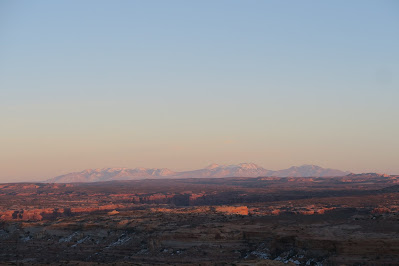
The hike is pretty straightforward. Relatively flat trail until a little before arch. The view is gorgeous and massive. You see the vast Utah's world with magnificent mountain range in the distance as below picture. 

It is already rewarding of this view, but this is just one of many great scenery. Of course another big highlight is the Colonnade Arch. Every arch is unique. This one has continuous arch together as you see in the below picture. So cool, isn't it? The arch even exists behind in the back of first layers of arch. People don't know much about the fact there are so many cool arches in addition to Arches National Park, for example in American Southwest. 

It is fun exploring under the arch as well. The bottom picture is now looking the canyon view from the arch. Priceless view. Because it was evening, the sun was going down and every minute the lightning was changing. It was warm orange sunshine hitting the rock. That makes the rock color really beautiful. 


When we came back to the trailhead, the sunlight got really orange and the scenery was different than the time we started (you can compare with the first picture). What a bonus. 


2025-06-06

Barrier Canyon Style Rock Art, Sego Canyon

So Fascinating to see Barrier Canyon Style Rock Art. 

One of the focus in 2024 Winter Trip to Utah was seeing Barrier Canyon Style Rock art. I previously wrote about Horseshoe Canyon hike to see Barrier Canyon Style (actually same as Horseshoe canyon) rock art. In Horseshoe Canyon we saw Holy Ghost Panel. Holy Ghost Panel is the most famous Barrier Canyon Style rock art. Besides that, Sego canyon is also a great place to see Barrier Canyon Style Rock art. For Holy Ghost Panel, you need to hike 10 miles, but for Sego Canyon, only 0.1 mile, which is good for people physically difficult to hike 10 miles. 

Barrier Canyon Style Rock art is found in Southeast Utah mainly. It is made a long time ago, as far as 7800 BCE.  Some are new as 500 BCE. Rock art is more known as Native Americans like Anasazi or Fremont style, which is more recent like 1000 years ago. Barrier Canyon style is really distinct from those. I really think Barrie Canyon style is fascinating. When I see them, I feel somewhat scary, sacred, and my soul is something connected with those images. Hard to explain. You need to really see them in person. 

The below picture is the most striking panel in Sego Canyon. This panel is really high. You see the top of tree is the bottom of the panel. Also you can tell how big the panel is based on the trees on the ground and on the top of cliff. The ground level might be higher when the panel was made, but still upper section of the panel cannot be reached easily. How could they paint these? 


The second picture above is the section of panel zoomed in. Looks like alien, especially the most left person with big "hole" eyes. The left picture is the focus of that one. Everyone has some decoration on their heads like horns. Those are made from lines. Some have earrings. 
This one in the left has chains of circles (another solid circle in the each circle). Each circle is connected with multiple lines. What does this mean? Interesting. 

Head's decoration has two layers. First with two thicker lines, then thinner three lines on them. So much detailed design. 

Due to the long time exposure and erosion, it looks like some rocks were fell off over the time.

This is another set of panel. This time it is petroglyph. Another detailed design. Decoration with circles for neckless. Each one's head has many decorations. The right person is crying?! The style of the humans are triangles. Huge shoulder width reminds me of the shape of Olympic swimmer body shape. 

Some panels are unfortunately vandalized heavily, although BLM erased some of them. It is still worth visiting here and you WILL feel the Barrier Canyon soul floating around. 

2025-05-23

Fiery Furnace, Arches National Park, Utah

 Fiery Furnace in Arches National Park. Relatively unknown in Arches.

When it comes to Arches, Delicate Arch is the first one people go. Actually Arches has much, MUCH more. 

Fiery Furnace hike needs to get a permit and you need to watch a video and listen to a short talk from a ranger at the Visitor center before the hike in the early morning. There is no official trail, and the whole purpose is "get lost" in the Fiery Furnace. Despite that, most people go to the same attraction spots of arches and interesting viewpoints. Due to internet, all are listed on whole kinds of hiking Apps. Another level people go to Fiery Furnace for canyoneering with ropes. I am not into that, so we sticked to the normal route. 


Overview
First of all, why is it called Fiery Furnace? The left picture is the overview of Fiery Furnace area and it explains everything....well for native English speakers.  For non-native English speakers need dictionary to understand. 

On the second thought, it doesn't need to know how it is named. Just accept the interesting geological shapes and enjoy is more natural thing. That removes the prejudice of the perception of places. 


Surprise Arch
From outside of Fiery Furnace area, arches cannot be visible, but once inside you can enjoy multiple arches and interesting shapes of rocks. The right picture is the first arch we saw. Surprise Arch.  


Kissing Turtle Arch


Kissing Turtle Arch. Cute huh?


Skull Arch
Skull Arch. This is my favorite spot in Fiery Furnace hike. It is very interesting two holes right each other, like glasses. In the future it is probably going to be just one hole in my guess. We had a snack here by looking up this. Very good time. 


I don't know what it is, but interesting shape (left picture). When it is not an arch, literally nobody explores. Nice to get solitude. 

Bottom is another structure, similar to kissing turtle arch, but with stripes. 


Overall it is a short hike around 3 miles. It is great to see some hidden arches in Arches National Park. A little hectic to do permit/pickup thing. To be honest, I wouldn't come back too soon due to low level of solitude, but doing once is a good experience. 


2025-05-09

Upper Muley Twist Canyon + Strike Valley, Capitol Reef National Park, Utah

 Very remote and solitude hike in National Park. 

With recent increased crowds in National Park, it is almost impossible to have a hike without anybody in National Park these days. This hike is an exception and exceptional. We did not see a single person for the entire hike of 10.3 miles + dirt road drive of 6 miles. The hike is scenic every single step. 

Upper Muley Twist Canyon is a hike within Capitol Reef National Park in Utah. It is 9.5 mile day hike of loli pop. The same trailhead has a short hike, 0.8 mile total, to the Strike Valley overview as well. We did both. It includes walking in wash and rim with some navigation, thus mileage is just an approximate. 

This hike has so many arches to see on the first half of hike, and the other half has massive vast valley view. From beginning to the end, it was quite a view packing day. The left picture is the very first arch to see. Very nice weather and the sunlight perfectly illuminate the arch and makes it look even more glorious. 
It is not only arches to see. Many magnificent rocks to see. The moon was in the blue sky and it added the uniqueness of the scene. 
More arch! Smooth 
More. Every arch is different. This one is fat. Reminded me of Phipps arch, another very fat arch in the Escalante area. 
More.
After looking at various arches from wash walk, climbing up to the ridge and coming back towards the trailhead. This way has a vast view like left picture. In some portions on the ridge, the left side is the vast view, and the right side is looking down the wash and the arches below. Looking down at the arches already looked up before was great. 
Even after the hike of 10 miles, still joy continues. The 6 mile of dirt road drive is super scenic as well. Next three pictures are the arches along the dirt road. What a day!
Double arch. 
Another double arch up high.